


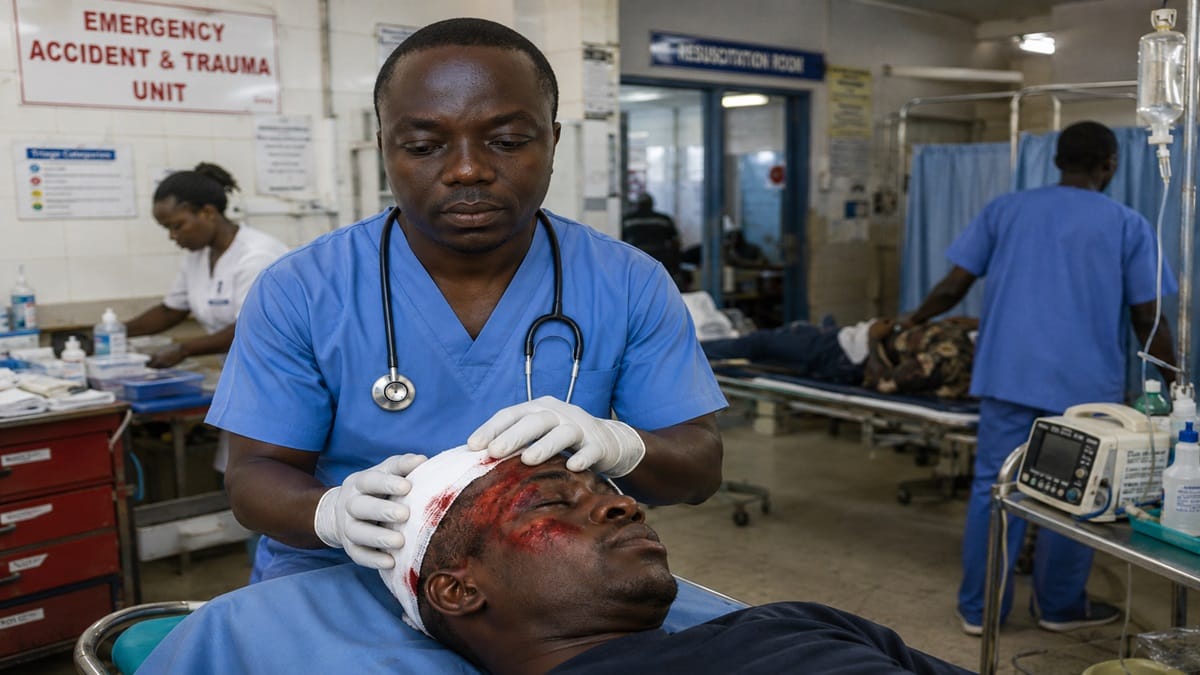
The emergency ward at 8:00 PM on a Friday does not smell like medicine. It smells of copper from pooled blood, burnt rubber, and the cheap, synthetic body spray worn by a young man who, less than forty minutes earlier, thought he was just taking a quick ride home. The cases get worse, especially when there is a funeral of a young person in town.
I am a trauma nurse. My hands are stained by the realities of our national transportation crisis. While the rest of the country views the Okada—our ubiquitous motorcycle taxi—as a convenient way to get from one place to another, I see it as a conveyor belt delivering fractured bones and shattered futures directly to my ward.
To the average commuter, the transaction is incredibly casual. You are running late, or there are no other available means of transport. It is also the fastest means of transport, allowing them to easily maneuver through congested traffic. The heat is oppressive. An Okada rider pulls up, weaves through the stationary cars, and nods. You pay your GH¢20, hop on the back pillion seat, and off you go. No helmet is offered. No safety checks are performed. You surrender your life to a stranger on two wheels, balancing your heels on metal pegs, completely exposed to the asphalt or the dirt road.
Public data show that Ghana records approximately 40 national road crashes daily, with motorcycles (“okada”) involved in about 27 of these incidents. These daily crashes result in an average of 46 injuries and claim at least four to six lives every single day, heavily affecting vulnerable road users under the age of 35. Statistics from the National Road Safety Commission of Ghana indicate that in 2020, road traffic crashes involving motorcycles killed 1,056 and injured 4,684 commuters. If this isn’t pathetic, what else is? You think it’s just a ten-minute shortcut. But in my ward, we see where that shortcut ends.
The Violent Trajectory of a Split Second
When a motorcycle crashes, the laws of physics are merciless. A car has a steel cage, crumple zones, and airbags to absorb kinetic energy. A motorcycle rider has none of these. A pillion passenger has even less protection.
When an unprotected rider hits a pothole, is clipped by a minibus (trotro), or swerves violently, the passenger becomes a human projectile. Without a helmet to absorb the impact, the human skull meets the concrete at full speed.
The medical terminology for what happens next is Traumatic Brain Injury (TBI) or head injury. But “TBI” is too clean a word for what I actually witnessed. The reality is the horrific sound of bone cracking against a curb (crepitation). It is the sight of a 24-year-old teacher arriving on our stretcher, eyes wide and unblinking, with blood pouring from his ears and nose—a classic sign of a basilar skull fracture. It is the rhythmic, desperate thud of a father’s body convulsing on a gurney because his brain is swelling uncontrollably inside a closed, cracked skull. Limited resources at my facility would compel our medical team to refer the client to a higher facility (Komfo Anokye Teaching Hospital).
These are the screams the public never hears. The public sees the Okada zoom past them in traffic. They don’t see the young man crying out for his mother in a state of post-traumatic delirium, completely unaware that he will never walk or speak clearly again.
The Tyranny of the “Golden Hour”
The management of the Komfo Anokye Teaching Hospital (KATH announced on 2nd June, 2026, that its Accident and Emergency Center was full and overflowing with waiting patients and was, therefore, not in a position to admit new emergency cases for the next 24 hours. You can imagine the fate of my client with TBI in my hospital from the above announcement. This facility receives critical cases from over 8 regions in Ghana. In trauma medicine, we live and die by a concept known as The Golden Hour. The Golden hour is the critical first 60 minutes after a traumatic injury. If a patient with a severe brain injury reaches a fully equipped trauma center and receives neurosurgical intervention within this one-hour window, their chances of survival and recovery skyrocket.
For every minute that passes outside that golden window, brain tissue dies from a lack of oxygen and mounting pressure.
THE GOLDEN HOUR TIMELINE [ 0 min ] ───► [ 15 min ] ───► [ 30 min ] ───► [ 60 min ] Crash Bystander Traffic Hospital Arrival Occurs Confusion Delay (Window Closes)
In Ghana, the Golden Hour is almost always stolen from us. It is stolen by bystanders who don’t know how to stabilize a neck, by gridlocked traffic that refuses to yield to ambulances, and by the sheer distance to a major hospital capable of treating a shattered head (it takes the ambulance 3 hours to reach the referral facility from my hospital). By the time an Okada passenger reaches my gurney, 45 or 50 minutes have often slipped by. It is obvious from the above that all the odds are against the survival of the victim who is already gasping for air.
We are left fighting a losing battle against a ticking clock. We scramble to insert intravenous lines, pump mannitol to reduce brain swelling, and bag the patient to keep them breathing, all while knowing that a simple GH¢300 piece of molded plastic—a helmet—could have kept them out of our ER entirely. A helmet turns a fatal brain injury into a minor concussion. It turns a lifetime of vegetative disability into a couple of bruises and a scary story to tell at dinner. However, demographic characteristics such as age, education, and occupation have been strongly associated with helmet use.
A Direct Call to Those in Power
We cannot continue to treat the symptoms of a broken system while ignoring the cause. To the National Road Safety Authority (NRSA) and the Motor Traffic and Transport Department (MTTD) of the Ghana Police: the blood on our scrubs belongs to citizens you are tasked to protect.
Allowing commercial motorcycles to transport millions of Ghanaians daily without enforcing basic helmet laws isn’t just a regulatory failure; it is a moral abdication. Every day you allow riders to operate without providing head protection for their paying passengers, you are signing a permission slip for another tragedy in my ward.
To the public who will be riding on the back of an Okada tomorrow morning: look at the rider. If he cannot provide you with a certified helmet, you are gambling your entire future for a 15-minute shortcut. Take it from someone who washes the blood off the stretchers when the gamble fails—the shortcut isn’t worth it.
Coming Next Month: Anatomy of the Crush: What happens to an Unprotected Skull
By Gabriel Afrane
Registered Nurse | Public Health Advocate
June 3, 2026
2




Well done. This script is an awakening call to action by all and sundry