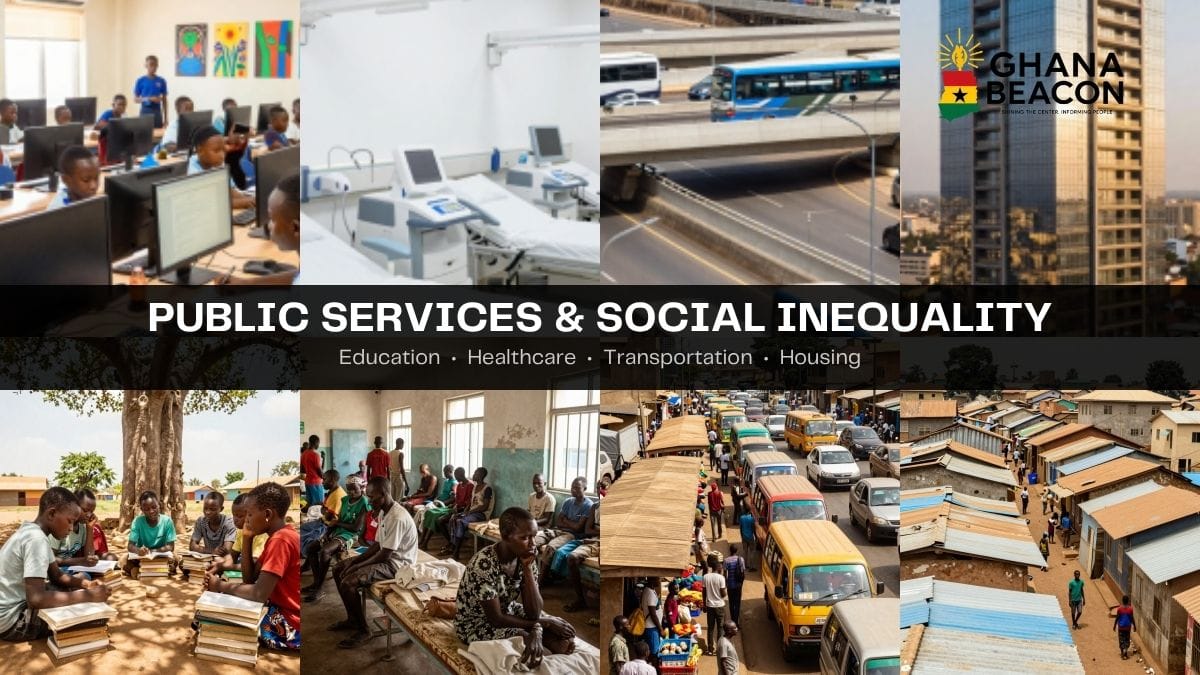
In Ghana, the quality of essential public services such as education, healthcare, transportation,
and housing remains a concern. Despite policy initiatives and development projects by
successive governments, significant challenges persist in many communities.
These issues continue to drive public debate on social inequality, accountability, and the
allocation of national resources.
Education: Unequal Access to Quality Learning
Education is widely recognized as a key driver of national development. Political leaders often campaign on promises to improve educational infrastructure, expand access to learning materials, and strengthen teaching quality nationwide.
Despite some progress, many schools, especially in rural areas, face challenges including inadequate classrooms, limited teaching materials, overcrowding, and insufficient access to technology. Some families enroll their children in well-resourced schools, but many depend on public institutions that face infrastructure and funding limitations.
Education experts have repeatedly emphasized that investing in quality education is essential to preparing the next generation of leaders and professionals. Without equitable access to educational opportunities, disparities between communities may continue to widen.
Healthcare: The Need for Stronger Medical Infrastructure
Healthcare is a significant concern in Ghana. Access to quality services varies by location and available resources. Recent government initiatives have aimed to improve hospitals, expand healthcare infrastructure, and strengthen service delivery. However, many health facilities continue to experience shortages of medical equipment, inadequate bed capacity, limited access to essential medicines, and staffing constraints.
Reports of overcrowding at major healthcare facilities, including statements from Komfo Anokye Teaching Hospital (KATH) management that its Accident and Emergency Unit had reached full capacity, have raised questions about access to emergency care. Health sector stakeholders continue to call for increased investment in healthcare infrastructure, improved maintenance of existing facilities, and the completion of stalled hospital projects to better serve growing populations.

Transportation: Road Safety Remains a National Challenge
Road transportation is the main mode of travel in Ghana. Road safety remains a significant national issue.
Road accidents continue to claim lives each year, prompting concerns about vehicle safety and road conditions. Road accidents result in fatalities each year, raising concerns about vehicle safety, road conditions, driver behavior, and enforcement of traffic regulations. This has renewed calls for improvements to road infrastructure and enhanced safety measures.
Transportation experts have long advocated expanding and dualizing major highways, improving road maintenance, strengthening public transportation systems, and enforcing road safety regulations more rigorously.
Safer roads and reliable transportation networks are considered critical to economic growth and public welfare.
Housing and Urban Development
Housing remains a challenge, especially in rapidly growing urban centers. Some residential areas have well-developed infrastructure, reliable utilities, and effective drainage systems. Other communities experience inadequate housing, poor sanitation, flooding, irregular water supply, and electricity challenges.
Affordable housing projects have been introduced to address housing deficits, but concerns remain about project completion, maintenance, accessibility, and affordability. Urban planners emphasize that sustainable housing development requires long-term investment in infrastructure, sanitation, public utilities, and community planning to improve living conditions for all citizens
Calls for Greater Accountability
Improving education, healthcare, transportation, and housing is widely regarded as a national priority, independent of political affiliation. Effective governance depends on measurable outcomes that improve the lives of citizens, not only on campaign promises.
Public expectations remain high for leaders to deliver practical solutions that address longstanding challenges and support inclusive growth. The debate over public service delivery raises a broader question: how can national resources be managed to ensure all citizens benefit from development and economic progress?
Transparency, accountability, and sustained investment in public needs are widely viewed as essential to achieving these goals.
By Gyimah Emmanuel
Registered Nurse | Public Health Advocate
June 4, 2026