


By Michael Abisa
Leader in AI & ML | Doctorate in Data Analytics
May 12, 2026
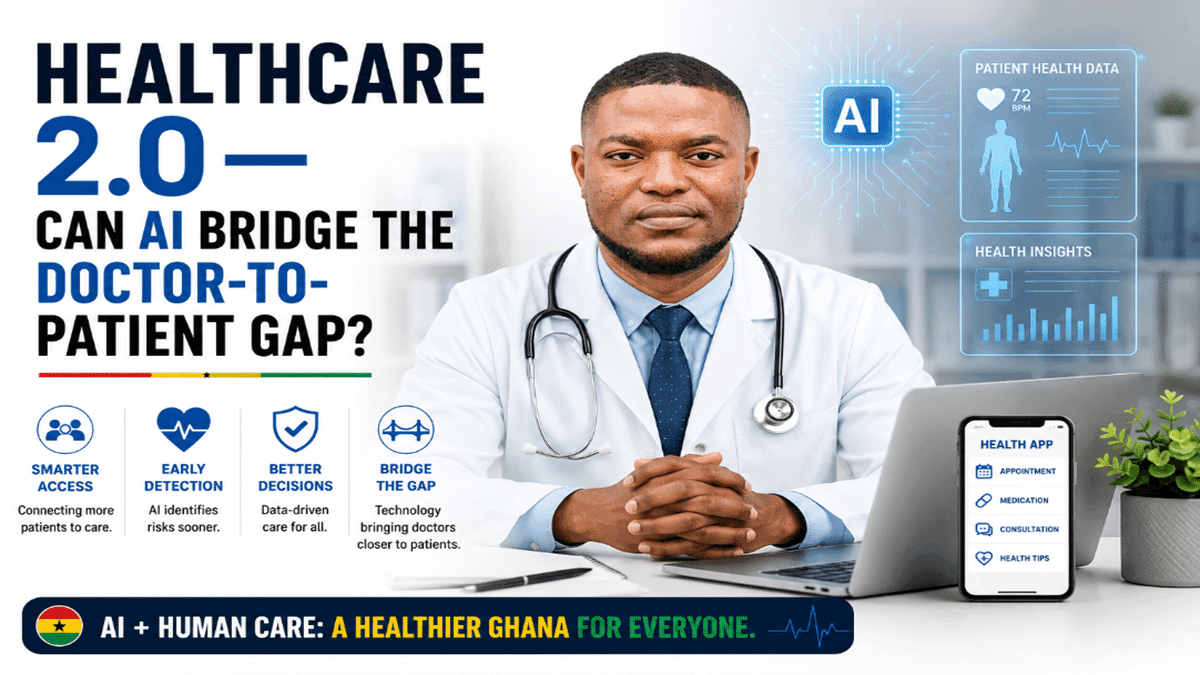
In Ghana, the doctor-to-patient ratio remains a challenge, particularly in regions outside Accra and Kumasi. Accessing specialist care in remote areas often requires extensive travel and incurs high costs. Recent developments in Artificial Intelligence are being implemented to address these disparities by improving access to quality healthcare services.
The National AI Strategy identifies healthcare as a priority area for digital intervention. The stated objective is to leverage AI so that geographic location no longer determines access to healthcare or life expectancy.
The Rise of the “AI Medical Assistant”
AI technologies are being introduced to support healthcare professionals in their work. In many CHPS compounds and district hospitals, AI systems now perform tasks that previously required a specialist’s presence.
- Automated Diagnostics: For instance, a nurse at Suma-Ahenkro Clinic can now use AI-powered software to analyze X-rays and CT scans to detect early-stage tuberculosis or pneumonia with accuracy levels rivaling those of senior radiologists. This allows local nurses to flag critical cases for immediate transfer.
- Dermatology in Your Pocket: With a simple smartphone photo, AI tools trained on diverse skin tones can help identify suspicious rashes or lesions. Crucially, these tools are being calibrated specifically for Melanated Skin, correcting the historical bias where AI only recognized conditions on lighter skin.
- Predicting Outbreaks: By analyzing anonymized data from pharmacies and clinics, the Ghana Health Service (GHS) can now use AI to predict malaria or cholera outbreaks weeks before they peak, enabling proactive distribution of nets and medicine.
Telemedicine and Virtual Consultations
AI-driven triage systems are being deployed to address the doctor-to-patient gap. These systems, accessible via platforms such as WhatsApp or dedicated applications, conduct initial patient interviews in local languages before referring patients to a healthcare professional.
These triage systems categorize patients according to the urgency of their condition:
- Low Risk: Provides home-care advice for a common cold.
- Medium Risk: Schedules a virtual call with a General Practitioner.
- High Risk: Alerts the nearest emergency center to prepare for a bypass or urgent intervention.
This triage approach is designed to allocate specialist attention to the most urgent cases, reducing the time spent on routine administrative tasks.
Solving the “Last Mile” Medication Problem
Supply chain management remains a significant challenge in healthcare delivery. AI is currently being used to improve the efficiency of the National Drone Delivery Network (Zipline).
Algorithms are used to predict which rural clinics may experience shortages of supplies such as anti-venom or specific blood types, based on historical data and seasonal trends. This enables pre-emptive deliveries, ensuring that essential medical supplies are available when needed.
The Expert View: Ethics and the Human Touch
The integration of AI in healthcare requires maintaining human oversight. Human-in-the-loop AI systems are designed so that while AI may provide diagnostic suggestions, final decisions and communication with patients remain the responsibility of qualified healthcare professionals.
Healthcare AI systems must comply with established privacy standards. Medical data is protected and must be used exclusively for patient care.
The Bottom Line
AI is a significant tool for expanding access to healthcare in Ghana. Expertise previously concentrated in major hospitals, such as Korle-Bu Teaching Hospital, is increasingly accessible to clinics in remote regions. These developments support progress toward universal access to quality healthcare.
About the Author
Dr. Michael Abisa specializes in Data Science and AI Management. This 10-week series in the Ghana Beacon provides information to support Ghanaians in understanding developments in technology and their implications.
Coming Tomorrow:
Day 9: Generative AI for the Small Business—From ChatGPT to Content Creation.
Health Tech Tip:
Have you used a health app recently? Always check if the app is verified by the Ghana Health Service or the Data Protection Commission to ensure your medical info stays safe!


