


For many Ghanaians, corruption is a daily reality rather than an abstract concept. Unofficial fees for passports or licenses, delays at ports, unfair recruitment, and inflated contracts impact citizens, businesses, and public institutions. These practices cost Ghana billions of cedis annually, undermine public trust, deter investment, and divert resources from essential services like healthcare, education, and infrastructure. As Ghana advances its digital transformation, policymakers and technology experts are asking whether Artificial Intelligence (AI) can help prevent corruption before it occurs. By automating high-risk processes, detecting suspicious patterns in real time, and limiting opportunities for human interference, AI could shift Ghana’s anti-corruption efforts from reaction to prevention.
The Blueprint: Deploying AI Across Ghana’s Key Sectors
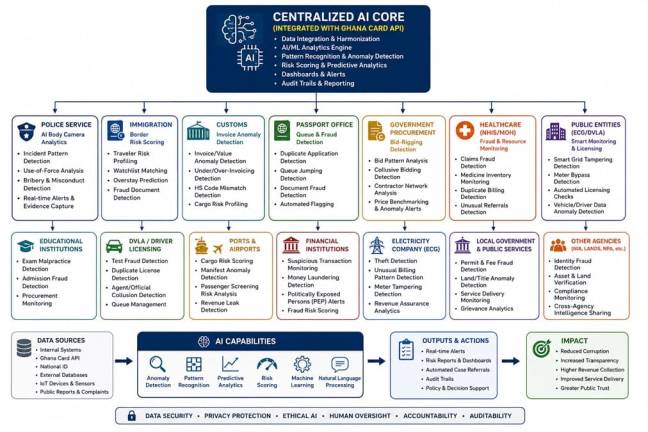
Examining the integration of targeted machine learning models into Ghana’s most vulnerable systems provides insight into how AI can improve governance.
1. Ports, Customs, and Airports (Tema Port & AIA)
The Port of Tema and Accra International Airport (AIA) are important sources of national revenue but remain susceptible to under-declaration, bribery, and smuggling.
- AI agents can scan bills of lading, compare declared cargo values with global market prices, calculate standardized customs duties, and automatically flag suspicious declarations for customs officers, reducing opportunities for fraud and manual manipulation.
2. Passport Office, DVLA, and Civil registries
Delays in processing passports and driver’s licenses are often exploited to solicit unofficial payments.
- AI-driven automated workflows can support the digitization of application processing. Applications can be automatically reviewed for completeness, verified against the Ghana Card database, and queued in order of submission. If an application is delayed or flagged, an AI system can identify the specific issue, reducing opportunities for unofficial payments.
3. Security Services, Police, and Public Recruitment
Recruitment processes for the Police, Immigration, Customs, and Military often face challenges such as nepotism, fraudulent credentials, and bribery. Police extortion during road checks is also a common concern.
- The AI Solution: AI-powered recruitment systems could anonymize applicants’ personal information—including names, hometowns, gender, and ethnic backgrounds—during the initial screening process, allowing candidates to be evaluated on merit rather than personal connections. The system could simultaneously verify academic qualifications through centralized databases and flag suspicious credentials for further review. In the Police Service, AI-enabled body cameras could automatically analyze interactions between officers and the public, detecting unusual stop patterns, repeated complaints, or conversations that may indicate requests for bribes. Any flagged incidents would be referred to internal investigators, helping improve transparency, accountability, and public trust.
4. Government Contracts and Public Procurement
Sole-sourced contracts with inflated values and collusive bidding practices result in significant financial losses for Ghana each year.
- The AI Solution: An AI-powered procurement portal could analyze bidding histories, company ownership records, tax filings, and contract data to identify potential corruption risks before contracts are awarded. For example, the system could flag multiple companies submitting bids from the same IP address, proposals containing nearly identical documents or metadata, or newly established firms winning unusually large government contracts without a proven track record. These alerts would enable procurement authorities to conduct additional reviews before awarding contracts, helping to reduce bid rigging, collusion, and procurement fraud.
5. Healthcare and Educational Institutions
Hospitals face issues such as theft of subsidized drugs and fraudulent patient billing, which impact the National Health Insurance Scheme (NHIS). In educational institutions, challenges include grade inflation and abuse of authority in grading.
- Predictive AI models can audit NHIS claims by identifying clinics with unusually high patient volumes or irregular prescription patterns. In education, centralized AI-proctored examination systems and algorithmic grading can help standardize assessment and reduce opportunities for exploitation.
6. Utility Providers & Financial Institutions (ECG & Banks)
The Electricity Company of Ghana (ECG) experiences significant revenue losses due to illegal power connections. Financial institutions also encounter complex money laundering schemes.
- Smart grids with machine learning algorithms can analyze local consumption patterns. If a transformer’s output does not align with the total from downstream smart meters, the AI can identify the area where power theft is occurring. In banking, AI-based anti-money laundering protocols monitor transaction patterns to detect and freeze suspicious accounts before funds are processed.
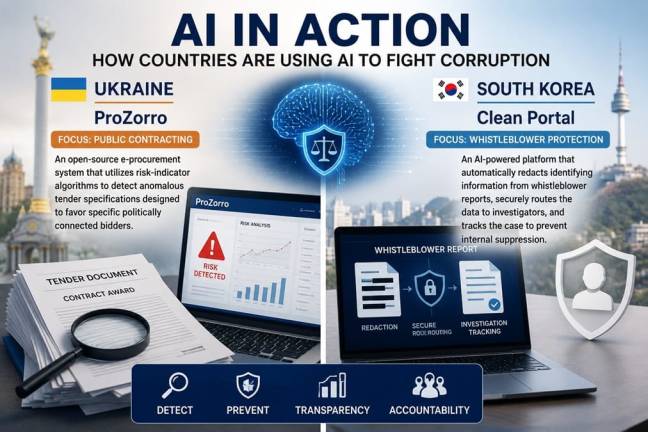
Global Precedents: Where AI is Already Winning
Several countries have already implemented AI-supported anti-corruption frameworks with positive results:
The Challenges Ahead
Despite the significant potential of AI, its implementation in Ghana faces several structural challenges:
- Data Silos: The effectiveness of AI depends on the quality and availability of data. In Ghana, public sector records are fragmented, and many departments continue to use paper-based recordkeeping.
- Systemic Resistance: Some individuals within public institutions may resist digitization efforts, sometimes using technical issues as a reason to revert to manual, cash-based transactions.
- Algorithmic Bias: If historical data used to train AI models reflects previous corrupt practices, the AI may unintentionally reinforce existing inefficiencies.
Editorial Perspective
Achieving a more accountable governance system in Ghana requires reducing arbitrary discretion in public administration. AI provides an opportunity to accelerate reforms beyond traditional bureaucratic processes. Integrating AI with the Ghana Card infrastructure and supporting enforcement of algorithmic findings can help shift the focus from assigning blame to establishing systemic accountability.
While the technology is available, effective implementation will depend on decision-makers’ willingness to support the transition to automated systems.
By Michael Abisa
Leader in AI & ML | Doctorate in Data Analytics
July 15, 2026


