


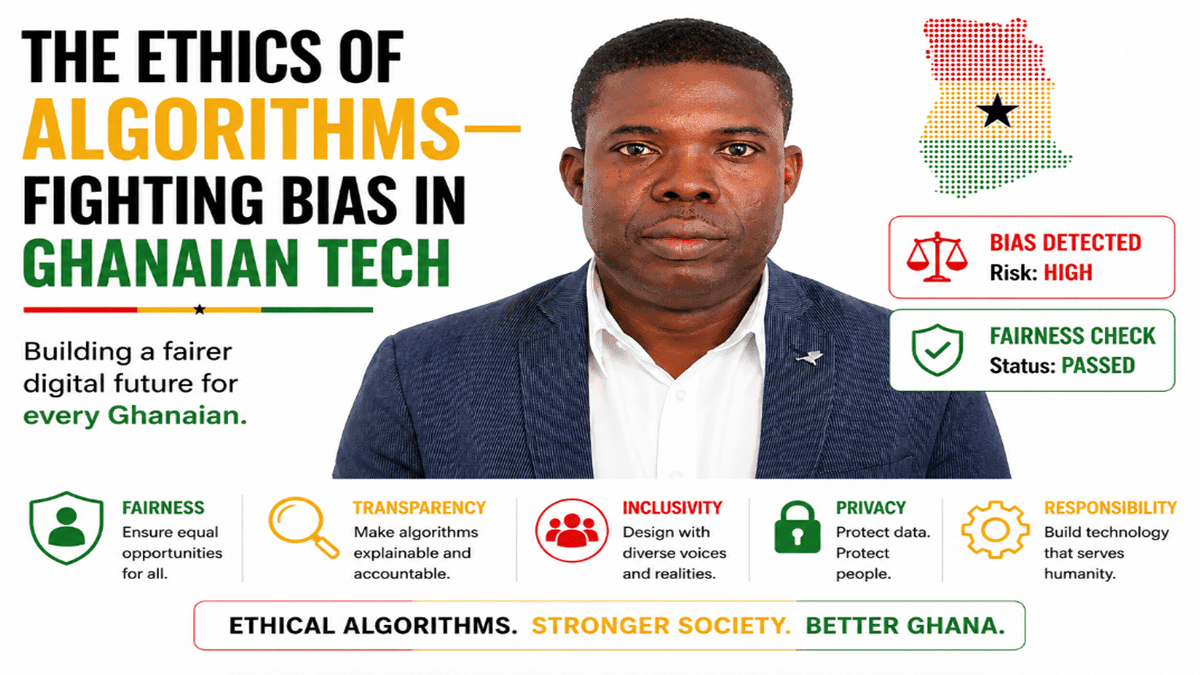
By Michael Abisa
Leader in AI & ML | Doctorate in Data Analytics
May 11, 2026
As Ghana develops Local Large Language Models, we encounter ethical challenges that surpass technical ones. AI mirrors its data; when data is biased, AI perpetuates existing prejudices.
Our commitment to diversity begins with language, which forms the foundation of our cultural expression.
Beyond the Big Three: True Linguistic Inclusion
Twi, Ga, and Ewe are widely spoken, but a truly Ghanaian AI must go further. Digital sovereignty requires LLMs to capture the nuances of Dagaare, Dagbani, Nzema, Kasem, and all languages across our 16 regions.
This extends beyond vocabulary to include accent and tone. A youth in Bolgatanga, an elder in Ho, and a trader in Drobo each speak with distinct rhythms. If AI cannot understand a citizen’s accent, it results in digital exclusion. Our National AI Strategy affirms that no language or dialect is superior.
Safeguarding Culture and Identity
AI will soon support sensitive systems, including land disputes and law enforcement. We must embed ethical Ghanaian values into our technology.
- Our AI must recognize the complexities of Stool and Skin lands and respect both traditional authorities and modern land title registries.
- We must ensure security-related AI never profiles citizens. Algorithms must not flag Ghanaians in traditional attire as suspicious or criminal based on clothing. For instance, a Ghanaian wearing traditional smocks/Fugu, beads, or specific cultural attire must never be classified by an algorithm as “suspicious” or “criminal” based on clothing
- Data for national AI systems must be balanced so that no tribe or community appears more central than others. Our AI should honor festivals such as Homowo, Hogbetsotso, Damba, and Aboakyer equally and accurately.
Fighting “Data Discrimination”
As an AI systems manager, I observe hidden biases emerging. We should conduct rigorous Bias Audits to address three major risks.
- AI-driven educational tools must not perceive children from low-income families or deprived areas as less intelligent or capable. Poverty is a circumstance, not a measure of ability.
- Healthcare and recruitment AI must disregard skin shade and body shape. We should not allow Western beauty standards to negatively impact Ghanaians through our software.
- AI must ensure fair distribution of government resources and new schools. Regions such as Oti and North East deserve the same priority as Greater Accra.
The Expert Take: Building a “Moral” Algorithm
Algorithms operate by rules, not emotion. As we establish the National Deep Science Institute, we have a responsibility to provide algorithms with a moral framework. This requires ensuring data reflects the diversity of Ghanaian life—rich and poor, urban and rural, from every tribe and language. Such inclusivity enables AI to unify rather than divide our nation
The central goal is for every Ghanaian to be represented accurately, fairly, and with dignity in our national technology. This is the true measure of ethical AI for Ghana.
About the Author
Dr. Michael Abisa is an expert and leader in Data Science and AI Management. This 10-Week series in the Ghana Beacon aims to equip Ghanaians with the knowledge needed to navigate a technology-driven future.
Coming Tomorrow:
Day 8: Healthcare 2.0—Can AI Bridge the Doctor-to-Patient Gap?
Join the Discussion:
Help shape Ghana’s digital future by sharing how your language or dialect can be better represented in AI, especially if you speak a minority language. Your feedback will guide digital inclusion efforts. Join the conversation today.


