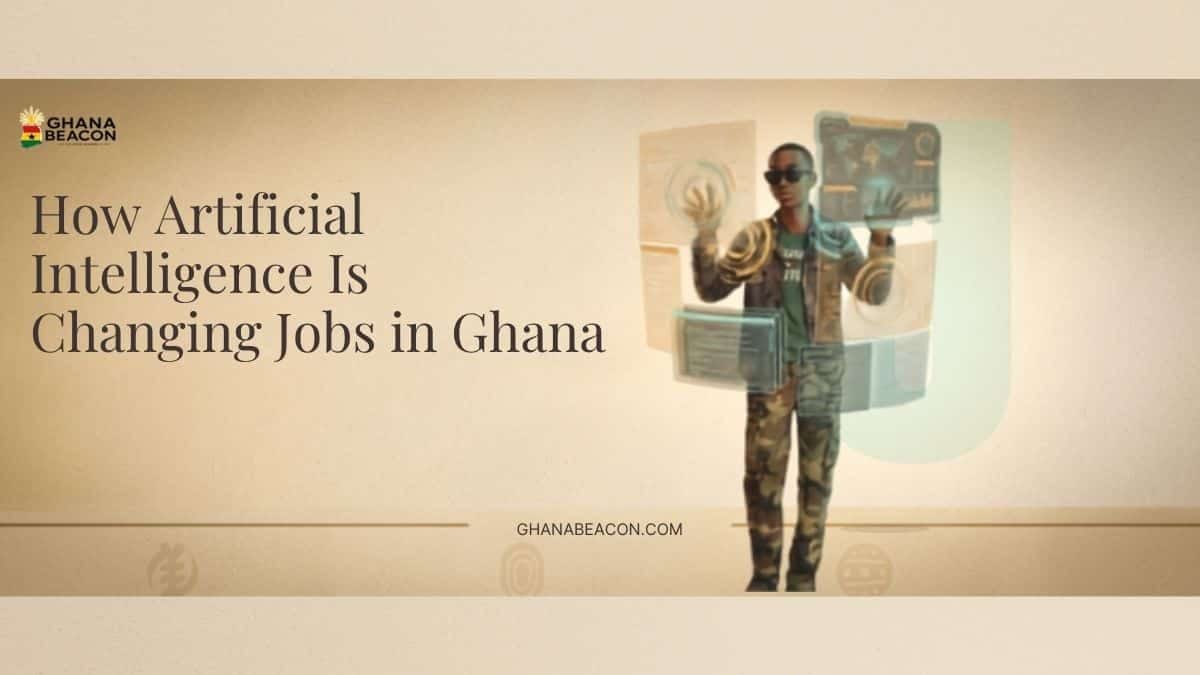
Artificial Intelligence (AI) is increasingly influencing operations across sectors, including banking, healthcare, media, and retail. While concerns about job replacement persist, experts indicate that the impact of AI on employment is more complex than simple substitution. AI is expected to automate specific tasks, create new roles, increase productivity, and change the skills employers require. For workers in Ghana and Africa, the primary challenge is adapting to work effectively with AI technologies.
AI Is Changing Jobs, Not Eliminating Work Entirely
Technological innovation has consistently transformed employment. The industrial revolution shifted manual labor to factory work, while computers reduced paperwork and increased demand for technology-related roles. AI represents a significant shift, with capabilities such as data analysis, text generation, image recognition, document summarization, language translation, and decision support. These functions primarily impact routine and repetitive tasks, rather than replacing entire professions. Most occupations require a mix of technical, interpersonal, creative, and strategic skills. AI is effective at structured tasks but continues to rely on human oversight, judgment, ethics, and relationship management.
Automation vs. Augmentation: Understanding the Difference
A common misconception is that automation and job replacement are identical outcomes of AI adoption. Automation occurs when AI performs repetitive or predictable tasks that previously required human effort. Examples include processing invoices, sorting customer inquiries, generating reports, or organizing schedules. Augmentation refers to AI enhancing human performance by supporting employees in completing tasks more efficiently, accurately, or creatively.
For example:
- A journalist may use AI to transcribe interviews in minutes instead of hours, allowing more time for investigative reporting.
- A banker may rely on AI to detect suspicious transactions while making the final fraud investigation decisions personally.
- A teacher can use AI to prepare lesson outlines but still provides classroom instruction, mentoring, and student assessment.
- A doctor may use AI-assisted diagnostic tools while remaining responsible for diagnosis, treatment decisions, and patient care.
The future of work is expected to involve collaboration between humans and AI, rather than direct competition.
Which Jobs Are Most Likely to Be Automated?
AI is projected to have the greatest impact on occupations that involve repetitive, rule-based, and predictable tasks.
These include:
- Data entry
- Routine bookkeeping
- Basic administrative support
- Standard customer service inquiries
- Inventory tracking
- Document processing
- Appointment scheduling
- Basic translation
- Simple report generation
Automation does not eliminate these jobs immediately. Many positions evolve as employees assume more analytical, supervisory, or customer-focused responsibilities.
New Jobs AI Is Creating
AI automation is also generating demand for new professions. Growing career opportunities include:
- AI trainers
- Prompt engineers
- Machine learning specialists
- Data analysts
- AI ethics officers
- AI auditors
- Cybersecurity professionals
- Digital transformation consultants
- AI project managers
- Robotics technicians
- AI-enabled marketing specialists
In addition to technical roles, most professions now seek employees who can use AI responsibly and effectively.
How AI Is Affecting Key Industries in Ghana
Banking and Financial Services
Banks in Ghana have increasingly adopted AI-powered fraud detection, digital customer support, and automated transaction monitoring. AI helps identify unusual financial activities more quickly than traditional manual reviews. These technologies enable bank staff to focus on complex customer needs, financial advice, compliance, and relationship management. Workers with digital literacy and AI skills are likely to become more valuable within the financial sector.
Customer Service
Many businesses now use AI chatbots to answer frequently asked questions, provide order updates, and assist customers outside normal business hours. Human agents remain necessary, as customer service professionals increasingly handle complex situations requiring empathy, negotiation, and problem-solving. Employees who combine strong communication skills with AI tools are likely to remain competitive.
Manufacturing
Across Africa, manufacturers are beginning to introduce AI-supported quality control systems, predictive maintenance, warehouse automation, and production planning. Workers previously engaged in repetitive inspection tasks may transition to roles in equipment monitoring, maintenance, programming, and process optimization. Technical and vocational education institutions play a key role in preparing workers for these changes.
Retail and E-Commerce
Retail businesses increasingly use AI to forecast demand, manage inventory, recommend products, and personalize customer experiences. Store managers use AI-generated sales forecasts to inform purchasing decisions, allowing employees to focus on customer assistance and improving the shopping experience. Small businesses in Ghana benefit from accessible AI tools for inventory management, marketing, and customer engagement.
Journalism and Media
Artificial intelligence functions as a newsroom assistant, supporting rather than replacing journalists.
Journalists can use AI to:
- transcribe interviews,
- summarize lengthy reports,
- identify trends in large datasets,
- generate headline ideas,
- translate documents,
- organize research.
However, investigative journalism, source verification, ethical decision-making, fact-checking, and storytelling remain fundamentally human responsibilities. With the rise of misinformation and AI-generated content, the value of trusted journalism is likely to increase.
Why Adaptation Matters More Than Fear
The primary workplace risk is resistance to change, rather than AI itself. Workers who do not engage with emerging technologies risk reduced competitiveness in the labor market. Employees who learn to use AI responsibly can improve productivity, increase efficiency, and enhance their career prospects. Adapting to AI does not require advanced programming skills.
Many professionals can begin by learning how to:
- use AI for research,
- summarize lengthy documents,
- generate presentation ideas,
- improve writing,
- analyze spreadsheets,
- organize meetings,
- brainstorm creative solutions,
- manage time more effectively.
These practical applications reduce repetitive work and enable employees to focus on higher-value activities.
What Employers Should Do
Employers have responsibilities during the transition to increased AI adoption.
Organizations should:
- invest in AI training for employees,
- establish responsible AI policies,
- protect employee privacy,
- encourage continuous learning,
- evaluate AI outputs before implementation,
- use AI to support—not unfairly replace—workers.
Companies that integrate technology into workforce development are positioned for stronger long-term productivity than those that rely solely on automation.
The Future of Work in Ghana and Africa
Africa’s young population presents both opportunities and challenges as AI adoption increases. If governments, educational institutions, employers, and workers invest in digital skills, AI could help improve productivity, create new industries, strengthen entrepreneurship, and increase Africa’s competitiveness in the global economy. Failure to prepare the current workforce may widen skills gaps and increase inequality. The future of work will depend on technological progress, education, workforce development, ethical governance, and lifelong learning.
Editorial Perspective
Artificial Intelligence is not inherently a threat to workers. As with previous technological changes, it is expected to transform job functions rather than eliminate the need for human skills. Employees who pursue continuous learning, develop digital skills, and collaborate with AI are better positioned for future opportunities. Employers that invest in workforce reskilling, rather than relying only on automation, can build more resilient and innovative organizations. The primary risk is the failure of workers and organizations to adapt to an economy where human and artificial intelligence increasingly operate together.
By Michael Abisa
Leader in AI & ML | Doctorate in Data Analytics
June 25, 2026