


By Dr. Michael Abisa
Manager of AI & ML | Doctorate in Analytics
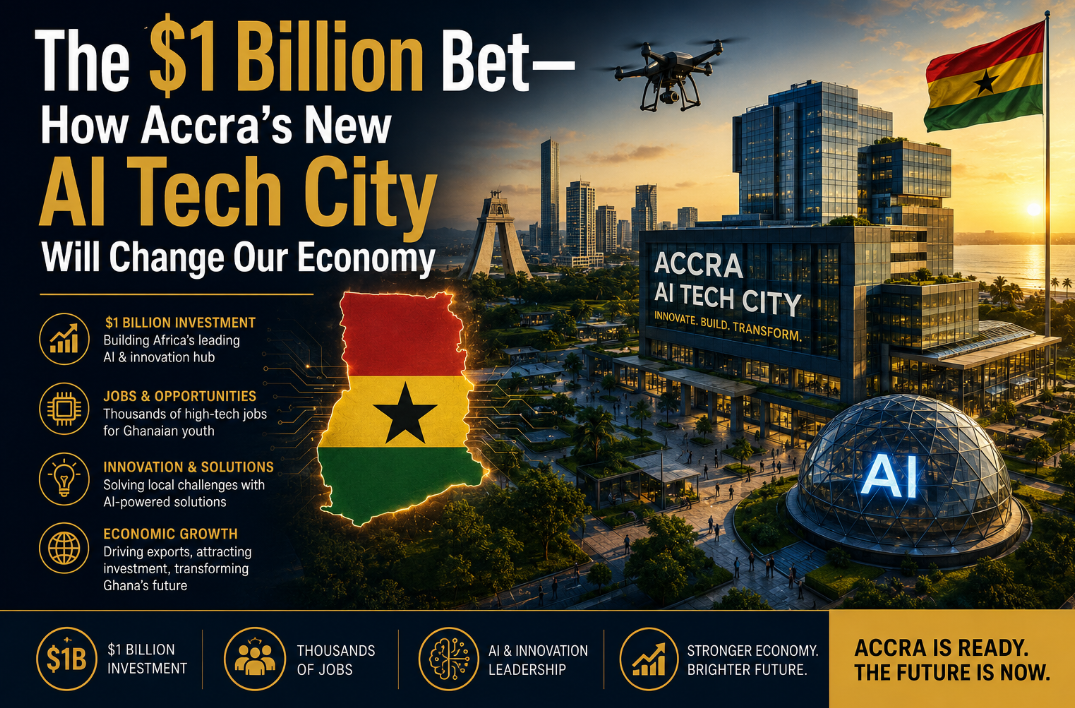
ACCRA, GHANA — A $1 billion investment is underway in the Greater Accra Region with the development of the Ghana-UAE Innovations & Technology Hub, also known as the AI Tech City, in Ningo-Prampram. This project represents a significant step in Ghana’s economic development strategy.
Scheduled for completion in 2026, the 25-square-kilometer AI Tech City is the largest technology investment in Ghana’s history. The project is expected to have direct implications for graduates and small business owners nationwide.
Beyond the Infrastructure: Africa’s Digital Nerve Center
The AI Tech City is supported by the UAE’s Ports, Customs and Free Zone Corporation (PCFC) and technology firm G42. The hub will include several key infrastructure components required for advanced AI development:
- Tier IV Hyperscale Data Center: This facility will provide high reliability and redundancy, enabling Ghanaian businesses to store data locally and reduce reliance on foreign data hosting services.
- AI Compute Hub: This facility will supply the computing resources necessary for developing applications such as automated customer service and agricultural prediction tools, supporting local developers in building advanced AI solutions.
- Startup Studio: A $120 million fund has been established to support the growth of 100 Ghanaian AI startups by 2030.
The “100,000 Jobs” Promise
The National AI Strategy (2025–2035) addresses concerns regarding local employment by linking the hub to the One Million Coders Initiative.
The initiative aims to train young Ghanaians in skills such as data annotation, cybersecurity, and machine learning operations (MLOps), with the objective of integrating them into technology companies expected to establish regional offices at the hub. Government projections indicate that the hub will generate over 100,000 direct and indirect jobs, which may help reduce the emigration of skilled professionals.
Why This Matters for the Ghanaian Economy
Ghana’s economy has historically depended on gold and cocoa, both of which are affected by fluctuations in global commodity prices. The development of AI infrastructure is intended to support the export of knowledge-based services.
- Increased FDI: The Ghana Investment Promotion Center (GIPC) projects a 25% increase in Foreign Direct Investment (FDI) inflows over the next five years due to the tech city.
- Currency Stability: Exporting digital services such as coding, data processing, and AI research is expected to generate foreign exchange that is not dependent on physical commodities.
- GDP Growth: According to official projections, AI is expected to contribute GH¢200 billion to Ghana’s GDP by 2030.
The Expert View: A Leapfrog Moment
A significant challenge in AI project development in Ghana has been the lack of advanced infrastructure, including high-speed servers and a reliable power supply, despite the availability of skilled professionals.
The $1 billion investment in Ningo-Prampram is intended to address these infrastructure challenges, enabling Ghana to participate directly in the digital economy. The project is structured to support the development, governance, and ownership of AI technologies by Ghanaians.
About the Author
Dr. Michael Abisa is a Manager of AI and Data Science with a Doctorate in Analytics. This 10-day literacy series in the Ghana Beacon aims to demystify the technologies shaping Ghana’s future.
Coming Tomorrow:
Day 3: Will a Robot Replace Me? The Truth About the 1 Million Coders Initiative.
Follow the Conversation:
What specific skill do you think Ghanaian youth should prioritize to get a job at the new AI Tech City? Share your thoughts below.


