


By Dr. Michael Abisa
Manager of AI & ML | Doctorate in Analytics
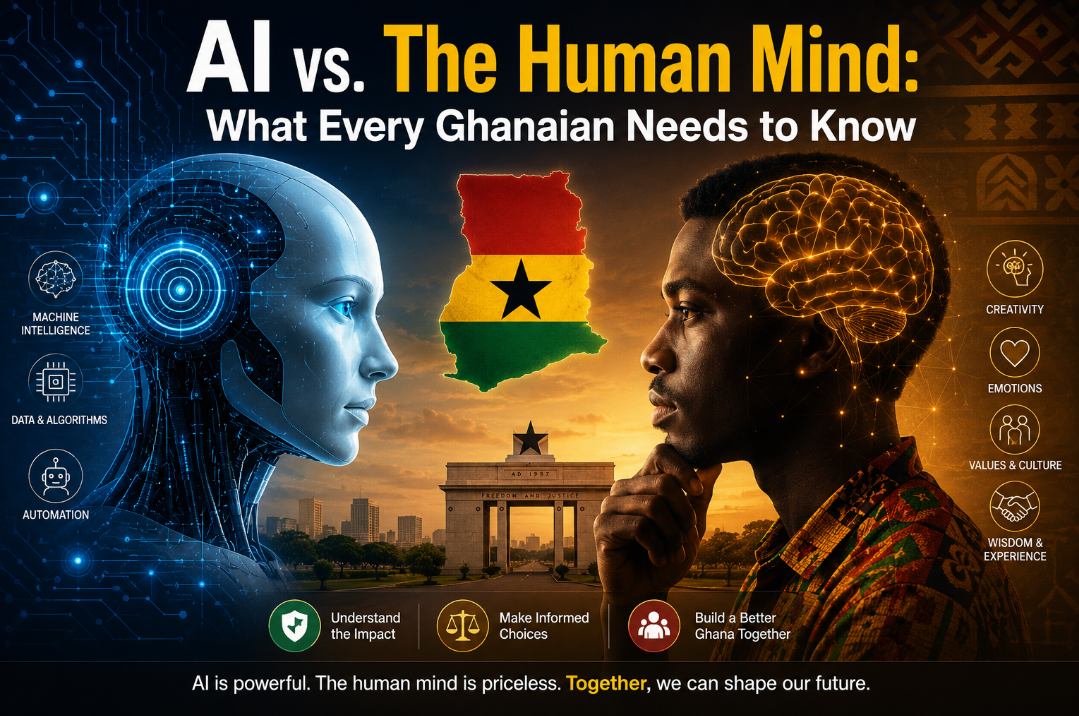
ACCRA, GHANA — In Ghana, discussions about Artificial Intelligence (AI) have become increasingly prominent across various sectors. Despite this growing attention, public perceptions are often shaped by popular media, which frequently portray AI as autonomous robots or other advanced machines.
As of May 2026, it is important to clarify that AI does not possess a mind comparable to that of a human. Instead, AI systems function as advanced pattern recognition tools, processing large volumes of data to identify trends and make predictions.
Pattern Recognition vs. Human Consciousness
Understanding AI requires distinguishing its capabilities from those of the human mind. AI does not possess knowledge or awareness; it operates by performing calculations based on input data.
For example, when a child learns to recognize a mango, they rely on sensory input and intuition, often requiring only a few examples. In contrast, an AI system typically requires a large dataset, such as thousands of images, to identify the distinguishing features of a mango, including shape, color, and texture.
The AI system constructs a mathematical model based on the data it processes. When presented with a new image, it compares its features with its model to determine whether it matches the characteristics of a mango. This process does not involve reasoning or understanding.
You are Already Using AI in Ghana Today
A common misconception is that AI is a technology of the distant future. In reality, AI applications are already integrated into everyday devices such as smartphones, making them accessible to many Ghanaians.
- Predictive text features in messaging applications, such as WhatsApp, utilize AI to suggest likely next words or phrases. These systems analyze large datasets of language use to identify common patterns in communication.
- Online retail platforms, including Jumia, employ recommendation engines powered by AI. These systems analyze user interactions to suggest products that align with observed preferences and purchasing patterns.
- Telecommunications companies such as MTN and Telecel use AI-driven fraud detection systems to monitor mobile money transactions. These systems identify unusual patterns that may indicate fraudulent activity and can intervene to prevent unauthorized withdrawals.
Why “Tech-Phobia” is the Real Risk to Ghana
Misconceptions that AI is a sentient entity capable of replacing humans can hinder technological adoption and national development. Professional experience in AI management indicates that AI serves as a tool to augment human capabilities, rather than replace them.
AI systems can increase efficiency and productivity by automating repetitive tasks, enabling individuals to focus on more complex and creative work.
This series will examine the capabilities and limitations of AI. Notably, AI systems do not possess context awareness or empathy, which are essential qualities in many aspects of Ghanaian society, such as interpersonal negotiations and cultural events.
The Bottom Line
AI is a tool, much like the tractor replaced the hoe or the computer replaced the typewriter. It is powerful software designed to handle “boring” patterns so that we can focus on the creative, high-value human work that will move Ghana into its next phase of development.
About the Author
Dr. Michael Abisa holds a Doctorate in Analytics and has extensive experience in data science and AI management. His work focuses on integrating technical solutions with organizational objectives. This series is published in the Ghana Beacon to provide accessible information on digital transformation.
Coming Tomorrow:
Day 2: The $1 Billion Bet—How Accra’s New AI Tech City Will Change Our Economy.


