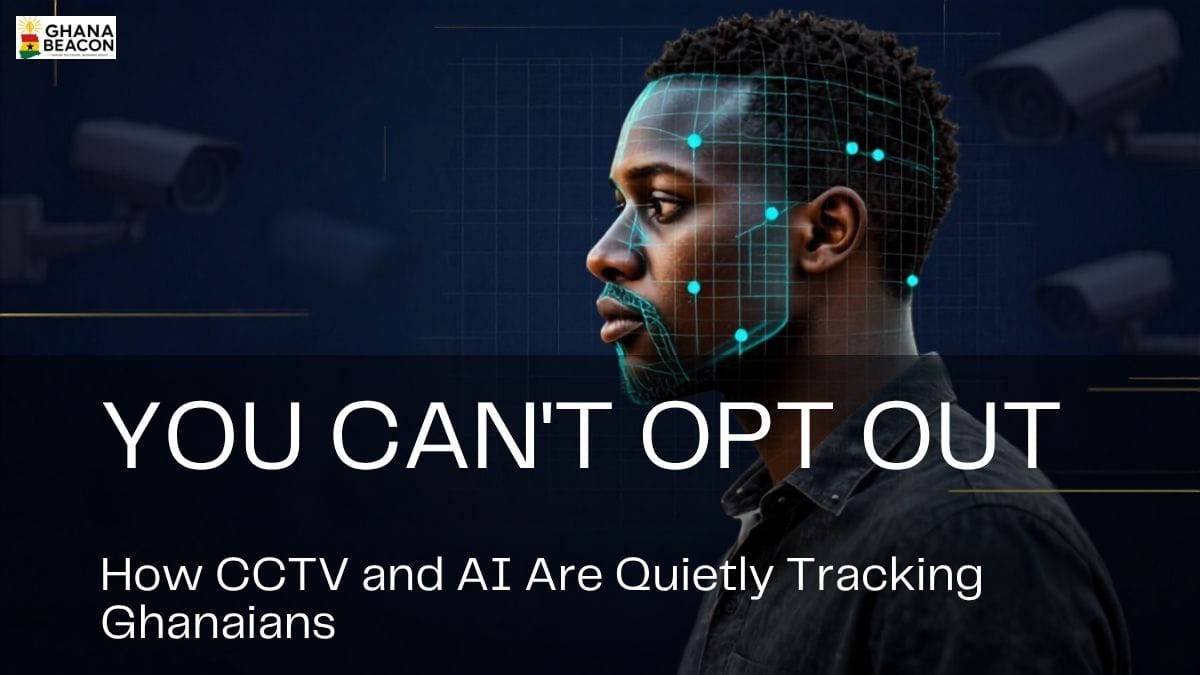
Across Accra, from Oxford Street in Osu to Nana Bosoma Market in Sunyani and corporate offices, a significant change is underway. Closed-Circuit Television (CCTV) cameras, once passive security tools, are now becoming active surveillance devices.
Advancements in Artificial Intelligence (AI) are transforming these cameras from simple recording devices into real-time, predictive surveillance tools. Although many Ghanaians take steps to protect their digital privacy, such as adjusting social media settings and avoiding AI-driven applications, opting out of surveillance in public spaces is not easily possible.
For those seeking to keep their facial and behavioral data out of AI training models, modern CCTV infrastructure presents a significant and unavoidable challenge.
From Video Streams to AI Training Grounds
Traditional surveillance required human review of footage after an incident. Today, integrated AI software can automatically process video feeds to perform:
- Facial Recognition: Mapping facial geometry to identify individuals in real time.
- Pattern and Behavioral Analysis: Tracking foot traffic, consumer dwell times in retail spaces, and detecting “anomalous” behavior.
- Demographic Profiling: Estimating age, gender, and emotional states from facial expressions.
A key concern for privacy-conscious individuals is that video data collected in public spaces may not remain local. Footage from locations such as supermarkets or fuel stations can be processed, tagged, and used to train AI models or support analytics platforms, often without the explicit knowledge or consent of those recorded.
The Friction with Ghana’s Data Protection Act
Legally, Ghanaians are not entirely defenseless. Ghana’s Data Protection Act, 2012 (Act 843) explicitly establishes that biometric data and identifiable imagery constitute personal data. Under the jurisdiction of the Data Protection Commission (DPC), organizations utilizing surveillance are bound by key principles:
- Notice and Transparency: Businesses must clearly display signage indicating that CCTV is in use.
- Specification of Purpose: Data must be collected for a specific, lawful reason (e.g., property security) and not quietly repurposed for AI commercialization or market research.
- Data Subject Participation: Citizens have the right to request access to data held about them or to have it deleted if it was processed unlawfully.
There is a significant gap between the provisions of Act 843 and the current use of AI in surveillance. When private organizations implement AI-powered surveillance systems, data processing often occurs in the cloud. It is difficult for consumers to track how their data is used or to ensure it is not repurposed for the development of external AI models.
The Illusion of Isolation
For individuals who are mindful of their digital privacy, the widespread presence of surveillance cameras poses a challenge. While it is possible to limit online data sharing, avoiding surveillance in physical public spaces such as transit systems, banks, and stores is impractical.
The adoption of wearable AI technology, such as smart glasses with cameras and real-time processing, extends data collection beyond fixed locations. In public areas of Accra and Kumasi, bystanders have no control over privacy settings on devices operated by others.
Bridging the Safeguard Gap
To address privacy concerns, Ghana’s regulatory framework needs to keep pace with the deployment of new surveillance technologies. The DPC’s Privacy Seal helps identify organizations that comply with data protection standards, but additional oversight is needed for video analytics systems.
- Mandatory AI Disclosure: Signage must do more than say “You are under CCTV surveillance.” If the system deploys facial recognition or behavioral AI, the notice should explicitly state it.
- Strict Purpose-Limitation Audits: The DPC must ensure that businesses buying AI security systems are not inadvertently allowing vendors to pool Ghanaian biometric data to train global AI models.
- Anonymization at the Edge: Regulators should encourage or mandate “privacy by design,” in which facial features are automatically pixelated or anonymized locally unless a verified security breach triggers an unmasking protocol.
Until regulatory measures are updated to address advances in surveillance technology, individuals will have limited ability to opt out of AI-driven data collection in public spaces
By Michael Abisa
Leader in AI & ML | Doctorate in Data Analytics
May 27, 2026