


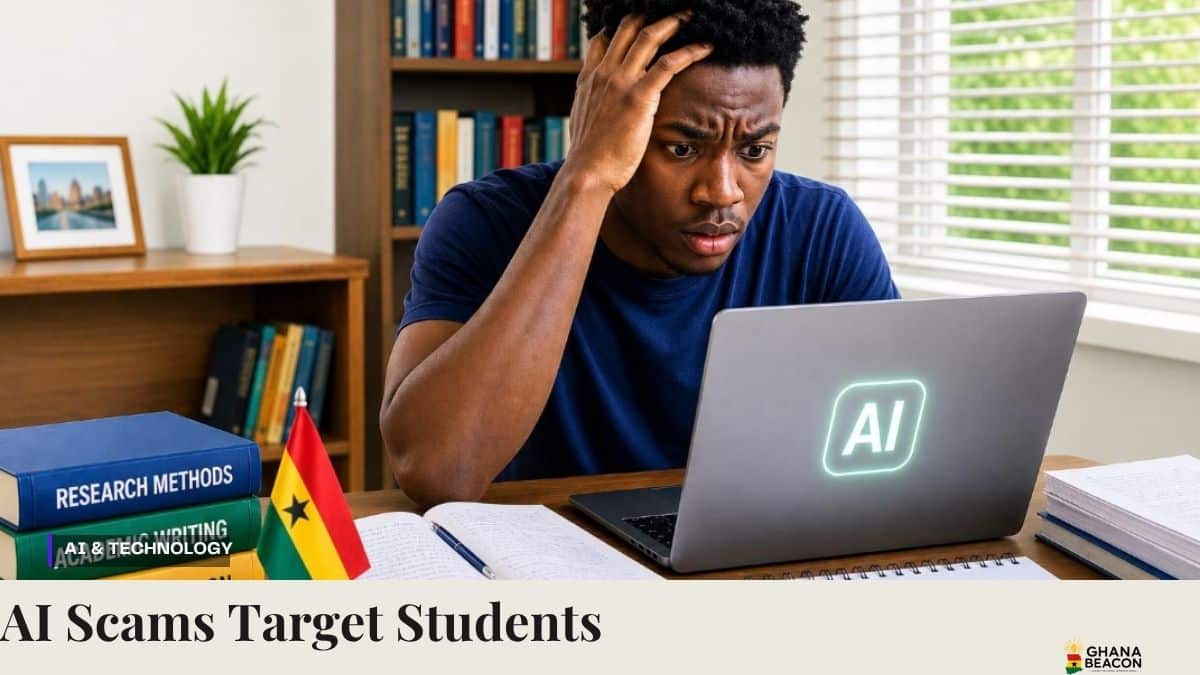
Artificial intelligence is changing education, communication, and online business in Ghana. At the same time, cybersecurity experts report that AI is enabling more sophisticated online fraud schemes that target students and young internet users.
AI-powered scams, including fake scholarship offers, fraudulent mobile money alerts, and impersonation scams on WhatsApp, are becoming more difficult to identify. Analysts note that students are particularly at risk due to their reliance on smartphones, social media, and online platforms for education and employment opportunities.
“Artificial Intelligence is making online scams smarter and harder to detect,” digital safety advocates say.
Cybercriminals are using AI-generated text, synthetic voice recordings, manipulated images, and automated chatbots to conduct online scams. Experts report that the increasing sophistication of these methods poses significant risks for students pursuing scholarships, jobs, internships, and financial assistance.
Recent warnings from Ghanaian authorities and online safety organizations have highlighted the rise of fraudulent scholarship schemes and impersonation accounts that use the names of government institutions and educational agencies. On Friday, 27th March 2026, the Cyber Security Authority (CSA) conducted cyber hygiene training for staff of the Ghana Tertiary Education Commission (GTEC) to strengthen institutional resilience against cyber threats. The training stressed the urgent need for sharper online vigilance and responsibility.
Students Increasingly Targeted
Cybersecurity observers say students are among the most attractive targets for online fraudsters because many are actively searching for:
- scholarships,
- admission opportunities,
- laptops and educational support,
- remote jobs,
- travel opportunities,
- and financial aid.
Scammers frequently use urgent messages to pressure victims into providing money or personal information.
A common tactic involves distributing fake scholarship messages through WhatsApp, Facebook, Telegram, and email. Victims are told they have been pre-selected for scholarships abroad and are asked to pay processing or registration fees using mobile money platforms.
Fact-checking organizations recently warned about fraudulent messages promoting fake “student laptop schemes” designed to steal personal information from students and parents.
Authorities in Ghana have also reported cases involving fake social media accounts impersonating scholarship institutions and government agencies. The acting Director-General of the Cyber Security Authority, Mr Divine Selase Agbeti, on March 7, 2026, at Volta Youth Festival at Ho Technical University, announced that a recent law enforcement operation in Vakpo led to the arrest of three people accused of impersonating senior public officials, including the Minister of Communications.
How AI Is Making Scams More Dangerous
AI tools can now generate professional-looking messages quickly, making them harder to distinguish from legitimate communication than earlier scams, which often contained spelling errors and suspicious language.
Experts say fraudsters are increasingly using AI to:
- write convincing emails,
- imitate official communication styles,
- create fake websites,
- generate realistic profile photos,
- clone voices,
- and automate conversations through chatbots.
Research examining evolving cyber fraud networks in Ghana found that scammers are increasingly relying on AI-driven tools, including fake videos and voice technologies, to support online deception.
Security analysts note that students may trust these scams because the messages appear polished and legitimate.
“Many young people assume that professional-looking messages must be genuine,” cybersecurity educators say. “But AI can now produce fake content that closely resembles official communication.”
Rise of WhatsApp and Mobile Money Fraud
Mobile money scams continue to be a prevalent form of digital fraud in Ghana.
Fraudsters often send fake payment alerts or impersonate customer service agents from telecom companies. In some cases, they contact victims about alleged account issues and request verification codes or money transfers.
A 2024 study on Mobile Money Fraud in Ghana concluded that variations in gender, age, educational attainment, financial status, and awareness of mobile money fraud significantly influence its prevalence. The researchers recommended that the Ministry of Communication and Telecommunication, in collaboration with the National Commission of Civic Education, implement comprehensive educational initiatives to inform citizens about mobile money fraud (https://rais.education/wp-content/uploads/2024/12/0452.pdf).
Cybersecurity professionals report that AI-generated text enables scammers to create mobile money messages that closely resemble official notifications.
WhatsApp is a common channel for fraud schemes due to its widespread use among students and families. Experts observe that many scams begin with:
- scholarship advertisements,
- investment offers,
- fake internship opportunities,
- or urgent requests for money from impersonated relatives.
Protecting Students From AI Scams
Digital safety experts recommend that students adopt stronger online verification practices.
Recommended precautions include:
- verifying scholarship offers through official websites,
- avoiding payments through unofficial mobile money numbers,
- refusing to share one-time passwords (OTPs),
- checking suspicious links carefully,
- enabling two-factor authentication,
- and confirming urgent requests through direct phone calls.
Students are advised not to trust opportunities shared exclusively via social media messages.
Education advocates suggest that schools and universities consider introducing digital literacy and cybersecurity awareness programs in response to evolving AI-powered fraud.
Growing Need for Digital Awareness
The expansion of AI technology across Africa is generating new opportunities as well as security concerns.
Educational AI systems and WhatsApp-based learning assistants are increasingly being developed for students in Ghana and West Africa.
Experts note that as AI tools become more accessible, cybercriminals are also adapting their methods.
Cybersecurity analysts indicate that public awareness could be a key defense against future digital fraud.
“Technology itself is not the problem,” experts say. “The real challenge is ensuring young people understand how these systems can be misused.”
Recognizing the warning signs of AI-powered scams may become essential for Ghanaian students to maintain online safety.
By Michael Abisa
Leader in AI & ML | Doctorate in Data Analytics
May 23, 2026


